Bizarre visit from the future! Our META Review of Good Luck, Have Fun, Don't Die
We reveal if Gore Verbinski's sci-fi film is worth watching – and put the opinions of other critics into perspective
With "Good Luck, Have Fun, Don't Die," Gore Verbinski has delivered his first directorial work in almost ten years. The film, starring Sam Rockwell, is a wild mix of science fiction, action, and comedy. But is "Good Luck, Have Fun, Don't Die" any good? What do other critics say? And does that match our KinoCheck review, or do we disagree with the other opinions? Find out in our META film review!
What it's about
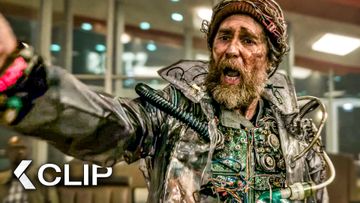
It starts like a strange joke. A man walks into a diner. He looks like he's been dressed by his trusted junk dealer. He relieves himself in front of the other guests. But no one pays any attention to him. The guests are busy with other things. They prefer to stare at their smartphones and scroll through social media. Then he claims that he comes from the future. But no one is interested. The punchline: he actually does come from the future. And it's completely ruined. Because of social media.
The Man From The Future, played by Sam Rockwell, grew up in a post-apocalyptic world dominated by AI. To prevent the enslavement of humanity, the eccentric stranger travels back in time. Over and over again. He has already entered the diner in Los Angeles 116 times to assemble the ideal group of comrades from among the guests there. Without success. But this time, things turn out differently than usual.
Plot interrupted
The premise and Rockwell's outfit are reminiscent of Terry Gilliam's equally eccentric time travel classic "12 Monkeys." Not the worst model for a sci-fi film that wants to tell the story of a time-traveling hero's desperate attempt to save the world. The bizarre opening scene of "Good Luck, Have Fun, Don't Die" leaves you wanting more. But unfortunately the rest of the film fails a little at crucial points. The flashbacks, for example, which repeatedly interrupt the plot about the time traveler and describe the backstories of some of the diner guests, are problematic. The structure chosen by director Verbinski and screenwriter Matthew Robinson detracts a little from the drive of the otherwise fast-paced film. Other critics, such as Brian Tallerico from RogerEbert.com, also criticize this:
"Just as we're getting involved with the escape from the diner, 'Good Luck' goes back in time, and that naturally does something to the pace that Verbinski can only half-recover. These backstories are thematically effective, but there could have been a better way to incorporate them into a narrative that doesn't lose momentum every time they arise. It's a credit to Verbinski's always energetic direction that the film doesn't fall apart completely."
Dystopian miniatures
In terms of content, the flashbacks themselves vary in quality. The director of "Pirates of the Caribbean" turns the backstories of the diner guests into small, more or less self-contained stories that could just as well pass for short episodes of the sci-fi anthology series "Black Mirror," as numerous other critics have also noted. Dystopian miniatures that take the dangers of modern technology to the extreme.
Particularly successful: the bitterly angry episode about a company that turns school shootings, which have become completely commonplace, into a business model. By simply offering the parents of children who have been shot cloned replacement children, who are designed as walking product placements for sugary drink brands. Change gun laws? Nah, better to keep consuming. As cynical as it is appropriate. Less successful: the episode about a horde of students who stare at their cell phones until they become a horde of zombies. Sure, very funny, teenagers and their cell phones. As patronizing as it is banal.
Criticism of technology criticism
When it comes to the technology-critical aspects of the story, reviewers' opinions differ the most anyway. For some, the film doesn't have much substantial to say about the risks of artificial intelligence. Others, on the other hand, praise it for being as thought-provoking as it is entertaining. YouTuber Chris Stuckman is among the latter group:
"But what's great about this movie is that, you know, there are aspects of it that are clearly supposed to be taken seriously. It is a bit of a warning about what could happen in the future, but it's also so funny and so lighthearted and whimsical even that it's clearly pushing the boundaries of absurdity as well."
Luke Hicks from the A.V. Club takes a completely different view, finding little to praise in the film. His damning verdict:
"This silly, simplistic sci-fi journey means to be thought-provoking, but the irony of its banality is more recoiling than provocative."
We wouldn't put it quite so harshly, but yes: the film's greatest weakness is that it rarely comes up with anything truly original to say about its central theme – the potential dangers of social media and AI. As satire, "Good Luck, Have Fun, Don't Die" remains too harmless. Especially since the use of exaggeration proves to be of little use here anyway, as it mostly only emphasizes the obvious. How subtly social media and now AI sometimes creep into our everyday lives, how this threatens to change us and our self-image, are nuances that are sought in vain here.
Sam Rockwell is convincing – but he's not the only one
What most critics, and we too, can agree on is Sam Rockwell's convincing portrayal of the eccentric time traveler. David Rooney of The Hollywood Reporter, for example, criticizes the script, but writes:
"Rockwell as always brings welcome eccentricity, but he's let down by dialogue without much spark."
We are also convinced by Rockwell's frenetic performance. But we would also like to give special praise to Juno Temple in the role of a single mother, who is rarely highlighted by critics. In the face of the cloned horror version of her shot son, her performance shifts seamlessly between grief and unease. By far the most nuanced performance in the film!
Have Fun
Otherwise, the title of the film says it all: "Have Fun." Fun seems to be the top priority for the accomplished Verbinski. And so he stages the central plot about the time traveler and the restaurant recruits as a bizarre action comedy, with his usual confidence and increasingly absurd style. It's a non-stop nocturnal odyssey in which the heroes must be on their guard against trigger-happy guys in pig masks, creepy killer toys, and a giant cat monstrosity. "It's like putting a drop of medicine in the cake," is how Verbinski describes his approach of adding a pinch of social criticism to the comedy. In the end, however, it seems to be all about the cake.
Conclusion: Overall, the verdict on Verbinski's film is relatively favorable. Despite occasional criticism of the handling of technology-critical aspects, there are rarely scathing reviews.
We at KinoCheck think: "Good Luck, Have Fun, Don't Die" is an absurd action comedy that provides a lot of fun. The sci-fi film's socially critical approach, on the other hand, is less convincing.